Editing styles by genre & format · 30 references · 6 clusters
Music Video & Performance
Module status: curated teaching references; links are searches, NOT verified direct video links. Edit hypotheses require viewing and timecode audit.
Method
For each video: locate a legally accessible version; log 3 cut decisions with exact timecodes, identify whether cut follows beat, lyric, gesture, action or story; distinguish shot design from editing; propose a 15-second recut.
Editing audit worksheet
1. Clip/version URL and rights/access status 2. Timecode in/out for each observed edit 3. Cut trigger: beat, motion, lyric, reaction, graphic, or narrative 4. Shot duration and before/after contrast 5. Impact on comprehension, energy, or emotion 6. Trailer/short-form adaptation versus original music-video cut 7. Confidence and source notes
30 references
01
Beat-Sync & Rhythmic Cutting
5 references
Technique exercise: watch one clip below twice, once for the story and once counting the cuts. Log three cut points against its "watch for" note, say what each cut does, and propose one alternate cut.
The camera tracks the trio in long unbroken stretches on a bare cyclorama, with only a handful of jump cuts that land on accents rather than on every beat.
Class question
Why might a director refuse to cut a dance this precise, and where do the few cuts that exist fall?
On each drum hit a new drum kit or amp appears in a line across the location, so the cut itself becomes the beat as the setups march through parks and subway stations.
Class question
How does duplicating the instrument on every hit turn a simple jump cut into a visual drum pattern?
What looks like one continuous train-window shot is built so that pylons, buildings and passing trains arrive exactly on beats and sounds in the track.
Class question
If there are almost no visible cuts, where is the rhythmic editing actually happening in this video?
Kept: Gondry's official Star Guitar video is the classic example of landscape objects timed to musical phrases.
02
Choreography & Performance Coverage
5 references
Technique exercise: watch one clip below twice, once for the story and once counting the cuts. Log three cut points against its "watch for" note, say what each cut does, and propose one alternate cut.
The film moves from a fake 1950s horror movie to a cinema audience around 4:10, then into the street and the graveyard, before the zombie dance takes over around 8:10.
Class question
How does the long narrative set-up change the way we watch the dance when it finally arrives?
Longer than 5 min: Landmark music-video short film (about 13:42); the full official film is the reference.
Wide shots of the uniformed ensemble locking into formation alternate with tight hard-lit close-ups, with cuts snapping on the drum accents through the factory set.
Class question
When does the edit choose the full formation and when does it cut in to a single dancer, and why?
Long wides of the seven members inside a huge marching-band and dancer formation on a concrete spillway are punctured by tight low-angle inserts of single members, with a high overhead formation shot around 2:43.
Class question
How do the cuts between a hundred-person wide and a single face make the choreography feel bigger?
New clip: The official ON MV is 5:55 and mostly narrative; the official Kinetic Manifesto Film (4:58) is the version built around the choreography and scale the card describes.
Each section jumps to a new costume and set, from the dark temple to the jungle stage, the ice cave and the pink finale, with very fast cuts landing on the hook.
Class question
How does changing the whole set at each section, rather than within a section, shape the song's build?
The camera roams across a theatre stage handing focus from one group of dancers to the next without cutting, until the final control-room and silhouette shots near the end.
Class question
Without cuts, how does the camera move decide who the viewer watches next?
Kept: The official Back On 74 video is a widely praised recent dance video staged as near one continuous take.
03
Narrative & Emotional Pacing
5 references
Technique exercise: watch one clip below twice, once for the story and once counting the cuts. Log three cut points against its "watch for" note, say what each cut does, and propose one alternate cut.
The story crosses between the pencil-sketch comic world and the live-action diner and flat, with the sketched hand reaching out of the page around 0:52 and the singer breaking free of the drawings near the end.
Class question
How does the edit make the jump between drawn and filmed worlds feel like one continuous story rather than two styles?
Present-day close-ups of Cash at the piano and the banquet table alternate with archive footage of his younger self, and the cutting speeds up as the song climbs toward the end.
Class question
What does each cut back to the young Cash say about the old man we return to in the next shot?
The relationship moves from an autumn road-trip montage to a long kitchen argument (around 4:10 to 6:10) played as a dialogue scene, then skips ahead in time to the later chapters.
Class question
Where does the film let the song carry the story and where does it stop for spoken dialogue, and why there?
Longer than 5 min: Official short film (about 14:55); the full short film is the reference.
The camera follows Glover through a warehouse in what plays as one take, while violence and running crowds fill the background behind the dancing in the foreground.
Class question
How does keeping the camera on the dance in front steer you away from what is happening behind it?
Held, posed tableaux such as the burning house and the line of women in white are cut against bursts of fighting, with the album title card dropping in around 2:54.
Class question
Why do the still, composed tableaux hit harder when they sit next to the moments of violence?
Kept: The official ELEMENT. video is widely cited for its photographic tableaux and slow-motion punctuation.
04
Experimental & Graphic Editing
5 references
Technique exercise: watch one clip below twice, once for the story and once counting the cuts. Log three cut points against its "watch for" note, say what each cut does, and propose one alternate cut.
Gabriel's face stays centred while everything around it is animated frame by frame: the train track around his head, the fruit face around 2:25 and the dancing chickens around 3:25.
Class question
How does keeping the face in the same spot let the stop-motion changes read as one continuous performance?
Longer than 5 min: Official video runs 5:01, one second over the cap.
New clip: The current link is a live performance; the stop-motion transformations are only in the original 1986 music video, now linked from the artist's channel.
The group was filmed performing backwards in long takes through Los Angeles streets so that, played in reverse, the rap syncs while people, cars and water move the wrong way.
Class question
How do the long takes help sell the reverse trick, and what would cutting more often do to it?
The video was made with laser scanners instead of cameras: Thom Yorke's face as a point cloud breaks up and reforms, with the scanned street and party scenes entering around 2:11.
Class question
With almost no cuts, what takes over the job of giving the video shape and progression?
New clip: The current link is the Scotch Mist webcast version; the official House of Cards music video with the lidar point-cloud imagery is a separate upload.
The pole performance on the empty stage plays in long uncut stretches for about two minutes before the video breaks into the surreal flight and fall sequence around 1:57.
Class question
Why hold back the cut for so long before the transformation, and what does that wait do to the ending?
Kylie walks the same block in what plays as one continuous circle, and with each lap another copy of her and of the street action is layered in, until several Kylies share the frame near the end.
Class question
How does repeating one move and adding a layer each time give a song structure without any cuts?
Replaced: The Windowlicker director's version runs 10:42 and is not a famous long take; Gondry's Come Into My World is an equally iconic experimental video under 5 minutes built on one repeating loop.
Original reference: Aphex Twin — Windowlicker
05
Live Performance & Concert
5 references
Technique exercise: watch one clip below twice, once for the story and once counting the cuts. Log three cut points against its "watch for" note, say what each cut does, and propose one alternate cut.
The broadcast cuts from Mercury's close-ups to over-the-shoulder shots of the packed stadium, around 1:16, 1:40 and 2:21, so the crowd's response becomes part of the performance.
Class question
Why do the shots from behind Mercury looking out at the crowd carry more weight than a straight crowd shot?
New clip: The current link is a 21-minute full set from an unofficial uploader; the Radio Ga Ga clip (4:02) from the Live Aid channel isolates the famous crowd clap that defines the performance.
Footage from the two Coachella weekends, with the yellow and the pink costume sets, is cut together with grainy black-and-white rehearsal and backstage film, building to a fast stage montage before the title card around 1:24.
Class question
How does mixing two different nights and rehearsal film change what we believe about a single live performance?
New clip: The current link is a static audio upload with no picture; Netflix's official trailer for the concert film shows the multi-night stage coverage and rehearsal intercutting.
Demme stays on wide and medium shots of the full band for long stretches with no crowd cutaways, only moving in to Byrne's face as the song peaks around 2:15 to 2:40.
Class question
What does refusing to cut to the audience do to the way we experience this concert?
New clip: The current link is a pair of deleted songs; A24's official clip of Burning Down the House shows the film's signature wide, long-held stage coverage of the full band.
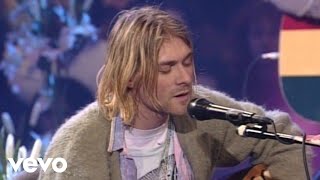
New clip: The current unedited clip runs 6:51; the official MTV Unplugged cut of The Man Who Sold the World (3:38) shows the same intimate coverage within the cap.
Shot largely from inside the crowd, the edit cuts on the pyramid's lighting changes, from blue grid to white triangles to rainbow lasers, so each light cue reads as a step in the build.
Class question
How does cutting on the light cues rather than on the beat help the viewer feel the musical build?
Kept: The official Alive 2007 live video is the band's own edit of their landmark pyramid show, under 5 minutes.
06
Contemporary Visual & Social Hybrids
5 references
Technique exercise: watch one clip below twice, once for the story and once counting the cuts. Log three cut points against its "watch for" note, say what each cut does, and propose one alternate cut.
The video moves through three worlds, a pink Eden, a white marble coliseum around 1:19 and a red underworld reached by a fall down the pole around 2:03, each with its own colour palette.
Class question
How does a single colour palette per world let the edit tell the story without any dialogue?
Hard cuts jump between unrelated single-colour vignettes, the yellow wall, the blue room with the nosebleed and the red desert, and the yellow wall gag returns several times before the dark red finale around 2:48.
Class question
Why does returning to the same yellow-wall set-up make the jumps to new vignettes funnier?
Wide-angle and rotating camera moves carry the cuts from the cafe to the bikers on the bridge, with tilted and upside-down frames around 0:21 and 1:35 landing on the track's sharp rhythm changes.
Class question
How do the spinning camera moves hide or replace cuts, and how do they match the song's sudden changes?
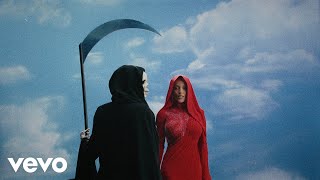
The video is bookended by the black-and-white record player motif, opens and closes around 0:04 and 4:51, and in between cuts between bold painted worlds such as the sky set, the blue-skinned demon set and the Grim Reaper duet.
Class question
What does returning to the same record-player image at the end tell the viewer about everything between?
Grainy 4:3 camcorder footage shot by the unseen friend is cut against widescreen school scenes, with the dropped camcorder around 2:23 and the tape playing back on an old TV around 3:27.
Class question
Who is holding the camera, and how does the switch between camcorder and film footage change what you believe is real?
New clip: The current link is the performance video; the camcorder POV and memory story belong to the official MV, and side B (4:37) carries the twist within the cap (side A is 5:34).

 Official upload4:56