Editing styles by genre & format · 30 references · 6 clusters
Martial Arts & Fight Sequences
Modul: 30 rujukan × 6 kelompok · Tarikh: 17 November 2026 · Fokus: keputusan editorial yang membentuk aksi, BUKAN senarai koreografi.
Terminologi: Semua tajuk "style" di bawah ialah label analisis pengajaran, bukan istilah rasmi industri atau kredit editor trailer. Filem, trailer dan potongan adegan boleh menunjukkan ciri yang berbeza: jangan mendakwa ciri tersebut wujud dalam setiap trailer tanpa menontonnya. "Perhatikan editing" bermaksud hipotesis pemerhatian untuk diuji di kelas.
30 references
01
Hong Kong Action Comedy & Stunt Clarity
5 references
Technique exercise: watch one clip below twice, once for the story and once counting the cuts. Log three cut points against its "watch for" note, say what each cut does, and propose one alternate cut.
After half a minute of studio logos, watch the trailer stack the hillside shanty-town chase, the bus hang and the mall glass smashes in wide shots that let each stunt finish before the next cut.
Class question
Why does a stunt read better when the shot is held wide until the landing, rather than cut into several close-ups?
New clip: Same film; replaced an outtakes re-upload with rights holder Fortune Star's restored trailer, which strings together the film's signature stunts.
In the bicycle chase through the narrow alleys from about 3:00, each gag plays out in a wide shot and then cuts to a pursuer's or bystander's reaction, so the joke lands in two beats.
Class question
How does cutting to a reaction after a stunt turn an action beat into a comic beat?
The title card at about 1:15 splits the trailer: before it, street and teahouse brawls; after it, the steel-factory finale with the bed of hot coals, held long enough to see full combinations.
Class question
When a fight is built on long combinations, how short can a trailer cut it before the skill disappears?
Near the end, around 3:30, the castle duel with Benny Urquidez is shown in wide two-shots that keep both fighters in frame for each exchange, between bold red title cards.
Class question
Why keep both fighters in one frame during a duel instead of cutting between singles?
New clip: Same film; replaced a training-scene clip with Fortune Star's restored trailer, which includes the celebrated Jackie Chan versus Benny Urquidez duel.
The trailer opens on the beach drill and lion-dance rigging, then builds to the warehouse ladder fight around 3:40, where Wong Fei-hung's poses are held between fast flurries.
Class question
How does holding a hero's pose for a beat change the way the next flurry of moves feels?
New clip: Same film; replaced a fan re-upload with rights holder Fortune Star's restored trailer.
02
Heroic Action & Wuxia Rhythm
5 references
Technique exercise: watch one clip below twice, once for the story and once counting the cuts. Log three cut points against its "watch for" note, say what each cut does, and propose one alternate cut.
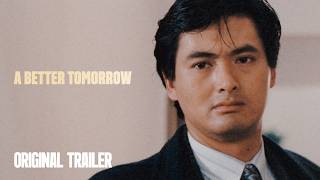
The trailer sets brotherhood and betrayal against gunfire: quiet dialogue close-ups in the middle give way to the night shootout and fireball, with the title card landing over the flames around 4:14.
Class question
How does placing tender close-ups next to violent wides make the violence feel heavier?
The cutting speeds up to more than 40 cuts a minute, and the church finale with doves bursting past the altar, around 2:39, sits between two-handed gunfire and blood-spattered faces.
Class question
What does an image like doves in a church add to a gunfight that pure action shots cannot?
Long, floating wide shots of two figures balanced on swaying treetops alternate with close-ups of Jen's face, and the duel resolves into stillness on the rocks around 2:01.
Class question
Why can a fight with few hits still feel tense when the shots are long and the camera floats?
Slow-motion swirls of red robes and golden leaves stretch each strike, and the duel ends on an insert of a blade with a single drop of blood around 3:19.
Class question
How does slowing the action down change whether we read a duel as violence or as dance?
Slow-motion close-ups of rain spraying off a hat brim, a fist and a splashing foot break the fight into fragments, so we feel the moments more than the full moves.
Class question
What is gained, and what is lost, when a fight is shown in fragments of detail rather than in full-body wides?
New clip: Same film; replaced a fan tribute edit with the official Rotten Tomatoes (Fandango) clip of the opening rain fight.
03
Southeast Asian Combat & Impact
5 references
Technique exercise: watch one clip below twice, once for the story and once counting the cuts. Log three cut points against its "watch for" note, say what each cut does, and propose one alternate cut.
Text cards carved into stone texture punctuate a fast run of real, wire-free stunts: the market chase over carts and between buildings, knee strikes in the fight club and flying elbows.
Class question
How does an edit prove to the viewer that a stunt was real and not faked?
After a slow opening of murals, elephants and fiery title cards, the cutting jumps to more than 30 cuts a minute as the fights escalate, including the temple hall with a floor full of defeated fighters around 1:47.
Class question
How does a trailer make each fight feel bigger than the last one?
Bold count-down cards set up the premise, the crime lord's tannoy line unleashes the tower, and the cut rate climbs through tight-corridor silat bursts to the title around 1:50.
Class question
How do cramped corridors and close framing change the rhythm of a fight edit?
Red title cards ('One undercover cop... against the entire underworld') pivot the trailer from quiet family scenes to a top-down car-chase shot, the train hammer fight and the white kitchen duel around 1:01.
Class question
How does a trailer signal a bigger, wider world than the first film without losing the close combat?
The first half holds on still, dark images and a few lines of dialogue; the second half breaks into close, bloody bursts of fighting before the title slams in around 1:36.
Class question
What does a slow, quiet first half do for the violence that follows?
New clip: Same film; replaced a Malay-language plot recap with Netflix's official trailer.
04
East Asian Precision & Swordplay
5 references
Technique exercise: watch one clip below twice, once for the story and once counting the cuts. Log three cut points against its "watch for" note, say what each cut does, and propose one alternate cut.
Red-glow text cards ('A warrior legend', 'Conquered & oppressed') frame the story, then the trailer cuts to the dojo fight against ten black belts, where rapid chain punches are held in clean medium shots.
Class question
How do you cut a fast Wing Chun flurry so every punch still reads?
At nearly 50 cuts a minute, the trailer slams from cold blue police drama into flashes of the alley duel with Wu Jing's knife and the nightclub fight with Sammo Hung.
Class question
When does very fast cutting add impact, and when does it hide the choreography?
The trailer opens on the film's first-person corridor assault, then mixes calm, teal-lit dialogue with motion-blurred fights, a motorbike sword chase and a bus crash before 'Coming soon'.
Class question
What does a first-person camera give a fight scene, and what does it take away?
Bilingual title cards ('The end at last', 'With these companions') mark each step up, from quiet dialogue to burning streets and Kenshin's sword rushes, ending on release-date cards.
Class question
How do title cards help a trailer pace its rise from story to action?
Text cards over blood-red brush strokes ('Bound for vengeance', 'Bound by the way of the samurai') split the slow, dark council scenes from the closing rush of the village battle.
Class question
With 13 heroes against more than 200 enemies, how does the edit keep the audience oriented?
New clip: Same film; replaced a full-length upload with Magnet Releasing's official trailer.
05
Hollywood Gun-Fu & Modern Action
5 references
Technique exercise: watch one clip below twice, once for the story and once counting the cuts. Log three cut points against its "watch for" note, say what each cut does, and propose one alternate cut.
Around 0:40 the rooftop gunfight drops into bullet time as Neo bends back under the agent's shots, then snaps back to full speed for Trinity's 'Dodge this'.
Class question
Why does slowing time at the single most important moment make it feel more powerful than slowing the whole fight?
New clip: Same film; replaced an unofficial all-fights compilation with the official Movieclips 'Dodge This' rooftop scene, the film's defining bullet-time moment.
The first minute is quiet grief and threat (the Mustang, the break-in); then neon title cards ('This fall', 'Wicked') pace the turn into Wick digging up his guns and going to war.
Class question
How does a slow, quiet setup make the audience want the violence that follows?
Each arena gets its own colour world, from candle-lit church gold to the neon-red Osaka hotel and its glass display cases, before the 'One way out' card launches the final fight montage.
Class question
How do strong colour and location changes help the audience follow a long chain of fights?
Kept: Same film; the current video is Universal Pictures' official trailer, under five minutes.
06
Global Hybrid, Long-Take & Epic Combat
5 references
Technique exercise: watch one clip below twice, once for the story and once counting the cuts. Log three cut points against its "watch for" note, say what each cut does, and propose one alternate cut.
Almost no cuts were detected: the camera chases Tyler Rake and the boy through stairwells, shops and alleys, and whip-blurred moves hide the stitches between takes.
Class question
Where could the editors have hidden cuts in this 'single take', and why does it matter that we cannot see them?
New clip: Same film; replaced a non-action beer-drinking clip from an unofficial channel with Netflix India's official upload of the film's famous one-take chase.
The prison-yard riot runs for minutes with only a handful of detected cuts, the camera pushing through the crowd as the fights, fire and pressure keep building.
Class question
How does a long take make a crowd fight feel bigger and more dangerous than fast cutting would?
Tabla beats and Hanuman imagery set a mythic pulse, then the trailer builds through club and kitchen fights to a single red 'Revenge' card around 2:17.
Class question
How can the rhythm of drums or music organise the cutting of a revenge trailer?
Red press-quote cards ('The most violent... India has ever produced', 'Stuck', 'Overdrive') alternate with brutal fights in narrow train corridors and cabins.
Class question
How does a confined setting like a train corridor shape the framing and cutting of a fight?
At about 30 cuts a minute the trailer stacks mythic images, a man roaring at a tiger, a sea of crowds, fire-lit forest battles, rising to the title around 2:59.
Class question
When the action is larger than life, how does the edit keep it feeling grand instead of chaotic?

 Official upload2:44