Editing styles by genre & format · 30 references · 6 clusters
Experimental & Avant-Garde
30 candidates in six clusters. Links are YouTube searches, not verified official clips. All editing observations are proposed audit lenses, not verified timecoded findings. Some films are not freely available in full.
Teaching audit worksheet
For each specific version: log publisher, verified link, rights, in/out timecode, shot duration, cut type, image/sound relationship, repetition, conceptual association, viewer inference, and comparison against continuity-editing norms. Avoid recreating intense flicker effects in class without accessibility warnings.
30 references
01
Soviet Montage & Intellectual Juxtaposition
5 references
Technique exercise: watch one clip below twice, once for the story and once counting the cuts. Log three cut points against its "watch for" note, say what each cut does, and propose one alternate cut.
How the cutting alternates the descending soldiers and riders with screaming close-ups and the runaway pram, stretching a short descent into an escalating chain of collisions that ends on the woman with the shattered glasses.
Class question
How does Eisenstein make the massacre feel longer and more violent than the real time the action would take?
New clip: Same sequence; the current 11-minute full-scene upload exceeds the cap, so this two-minute excerpt of the Odessa Steps massacre is used (no official upload found).
The trailer compresses Vertov's devices into a minute: the cameraman perched over the city, a split-angle Bolshoi, superimpositions, and a burst of very short shots around 0:32 to 0:37 cut to the Alloy Orchestra score.
Class question
What does showing the camera and the editor inside the film change about how you read every other shot?
After the intertitle 'In the name of God...', the cut runs from a baroque Christ through Buddhas, masks and carved idols, then 'and Country' turns the same chain toward medals and epaulettes, so the idea is built entirely in the joins.
Class question
What argument does the sequence make that no single shot in it could make on its own?
Short shots of nozzles, hands and soaked bodies alternate with wide views of the crowd scattering, and the jets of water become graphic lines that carry the rhythm from shot to shot until the 'End of fifth part' card.
Class question
How does the editing turn a hose, a tool, into a weapon and an image of state power?
New clip: Same work; the full-film link exceeds the cap and the slaughterhouse finale clip could not be downloaded for checking, so the fire-hose attack, the film's other famous montage set piece, is used.
The march and its brutal suppression are intercut with breaking river ice, and the closing images of walls and towers push the story out into a symbolic, almost abstract ending.
Class question
What does the breaking ice tell you about the uprising that the shots of people alone do not?
Replaced: No clean, non-essay upload of Bruce Conner's A Movie exists (the only short one overlays narrated analysis), so the slot uses Pudovkin's ice-floe finale of Mother, a canonical Soviet associative-montage sequence.
Original reference: A Movie (1958) — Bruce Conner
02
Nonlinear Time & Fragmented Narrative
5 references
Technique exercise: watch one clip below twice, once for the story and once counting the cuts. Log three cut points against its "watch for" note, say what each cut does, and propose one alternate cut.
Fragmented inserts (a flower on the path, a shadow, a key, a hand at the door, a phone off the hook, a turning record) build the actions that the film will later repeat with small changes.
Class question
Which objects become anchors for you, and how do they let you follow a story that keeps resetting?
New clip: Same work; the current link is the full 14-minute film, replaced by the official excerpt from the Film-Makers' Cooperative, Deren's distributor.
The same couple appears in corridors, gardens and a bedroom with no clear before or after, while the dialogue ('I've waited a long time for you' against 'I'm sure you're making it up') contradicts what the images seem to show.
Class question
Which cues would normally tell you the order of these scenes, and how does the film remove them?
The film is built from still photographs: after the opening text cards, Orly's jetty is assembled shot by shot and then a single still of the woman's face is held for roughly 25 seconds.
Class question
How does a held still image create a sense of memory that moving footage would not?
New clip: Same work; the film's opening as presented by the Whitechapel Gallery is the most widely viewed short excerpt and shows the still-image method directly.
Black-and-white and colour, childhood and adult scenes, a burning barn and a dream of a house slide into each other under one continuous voice reading a poem.
Class question
What links one image to the next here if it is not the order of events?
Each shot is a fixed, frontal tableau of carpets, monks and ritual gestures; the camera does not move, and only a couple of hard cuts (around 0:31 and 0:52) jump to a new composition.
Class question
With no camera movement and almost no cuts, what carries the rhythm of this scene?
New clip: Same work; replaced an unofficial upload with Criterion's official scene clip.
03
Structural Film, Repetition & Duration
5 references
Technique exercise: watch one clip below twice, once for the story and once counting the cuts. Log three cut points against its "watch for" note, say what each cut does, and propose one alternate cut.
The camera follows one cause-and-effect chain (a rolling cart, a burning fuse, a barrel, foam, a flame, a rolling tyre) so that time feels continuous even where hidden joins stitch the takes together.
Class question
Where would you expect a cut here, and why does the film work so hard to hide them?
Replaced: Wavelength exists on YouTube only as unofficial 45-minute full uploads with no short excerpt, so the slot uses the Guggenheim's official excerpt of The Way Things Go, a famous duration-and-continuity work.
Original reference: Wavelength (1967) — Michael Snow
One fixed view of a single room: each character's short action loops endlessly while new loops are layered in, until the room is packed with over thirty people who never collide, then they drop out one by one.
Class question
How does a rule as simple as 'add one loop at a time' create rising tension without any cuts?
Longer than 5 min: Short film that is the reference; its loop structure only reads when watched whole (about 8 minutes).
Replaced: Zorns Lemma is only available as unofficial hour-long uploads; Rybczynski's Oscar-winning Tango is the best-known short built on a strict repetition system.
Original reference: Zorns Lemma (1970) — Hollis Frampton
The camera never moves: a fixed shot of an institutional corridor alternates every few frames between two zoom settings, so the hallway seems to pulse in and out (the detector registers it as a cut on almost every quarter second).
Class question
With one locked-off view and no story, what does the alternation make you notice that a normal shot would not?
New clip: Same work; the current 10-minute upload exceeds the cap, so a two-minute excerpt that shows the alternating focal lengths is used (no official upload exists).
The patterns of bars on screen are the same optical marks that produce the music, so each note change is also a picture change, and the columns multiply and recolour as the piece builds.
Class question
If image and sound come from the exact same source, which one is leading the edit?
Longer than 5 min: Short film that is the reference, an official NFB upload of the complete 7.5-minute film.
Replaced: Arnulf Rainer is a full-screen black-white strobe film available only in unofficial uploads and unsafe to embed for photosensitive viewers; McLaren's Synchromy is the NFB's official, widely taught structural film where image and sound are the same marks.
Original reference: Arnulf Rainer (1960) — Peter Kubelka
Frames from a 1980s horror film are printed so that the sprocket holes, multiple exposures and slipping frame lines become the subject, with the image jumping and doubling before it bursts to white.
Class question
What happens to fear when the film strip itself, rather than the monster, becomes the threat?
New clip: Same work; replaced an unofficial 10-minute rescored upload with the official teaser from Index Edition, the film's publisher.
04
Surrealist Collision & Disruptive Continuity
5 references
Technique exercise: watch one clip below twice, once for the story and once counting the cuts. Log three cut points against its "watch for" note, say what each cut does, and propose one alternate cut.
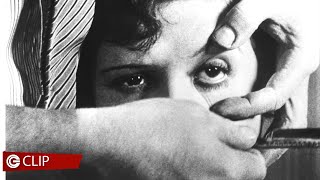
A man sharpens a razor, looks at the moon, and a thin cloud crossing the moon is cut against the razor crossing a woman's eye, so the graphic match itself delivers the shock.
Class question
Why does the cut to the cloud and moon make the next shot more disturbing rather than less?
New clip: Same work; the current link is the full 16-minute film, replaced by a 40-second clip of the famous razor-and-moon opening from a distributor channel.
Picabia and Satie leap in slow motion around a rooftop cannon and load it, the camera looks down the barrel, then after the title the film tilts and inverts the Paris skyline and cuts to dancing paper dolls.
Class question
How do slow motion, inversion and repeated jumps turn a simple prank into a rhythm?
New clip: Same work; the current link is the full 20-minute film, replaced by a widely viewed under-3-minute excerpt of the cannon prologue and opening.
Painted lips, a pendulum-like swing, circles, triangles and kitchen objects recur through a kaleidoscopic lens, so that a face and a pot lid start to read as the same kind of shape.
Class question
What happens to a human face when it is edited with the same rhythm and treatment as a machine part?
The clergyman moves through corridors, a ballroom and a chequered hall with no spatial logic, and the clip ends on his staring eyes overlaid with other images, mixing inner vision and outer action.
Class question
What tells you these shots belong to one mind even though the spaces do not connect?
The dancer's leg lifts in a forest and lands in a living room, a spin continues from a gallery into close-up, and a leap crosses from one landscape into another, so continuity of movement replaces continuity of place.
Class question
What holds the space together when every match-on-action lands somewhere new?
Replaced: Beckett's Film exists only as unofficial 22-minute full uploads; Deren's two-minute A Study in Choreography for Camera is the canonical short example of disruptive continuity.
Original reference: Film (1965) — Samuel Beckett
05
Music Video, Video Art & Mixed Media
5 references
Technique exercise: watch one clip below twice, once for the story and once counting the cuts. Log three cut points against its "watch for" note, say what each cut does, and propose one alternate cut.
After the title is built line by line, slow aerials of clouds, cliffs and canyons give way to towers, traffic, crowds and time-lapse streaks of city light as Glass's score accelerates, ending on a circuit-board city grid.
Class question
How does the shift from nature to city change the speed of the images, and who sets that speed, the picture or the music?
Repeated gestures of carrying and labour (sacks hauled up a mine slope, grain winnowed, loads on heads) are cut against traffic, pylons and smokestacks, with the title letters used as windows onto the footage.
Class question
What argument about work and industry does the cutting make without a single word of narration?
There is no camera: moth wings, leaves and petals were pressed between strips of clear tape and printed, so every frame is a new object and the image flickers in organic textures with no continuity at all.
Class question
If every frame is a different object, what makes the film feel like a single flight rather than random noise?
Replaced: Dog Star Man exists only in unofficial uploads longer than five minutes per part; Brakhage's Mothlight is his most widely seen and taught film and runs about three minutes complete.
Original reference: Dog Star Man (1961–64) — Stan Brakhage
Stripes, waves, dots and circles painted straight onto the film pulse to a dance-band tune, and in the last minute the same abstract rhythm turns into stencilled lettering for Post Office parcel rates.
Class question
How does the film earn your attention for an advert before it ever tells you what it is selling?
Replaced: The Dante Quartet runs over six minutes and exists only in unofficial uploads; Len Lye's A Colour Box, painted directly on film as a Post Office advert, is the landmark hand-painted music film and runs three minutes.
Original reference: The Dante Quartet (1987) — Stan Brakhage
Colourised dancers, a TV Guide cover used as a title card, and synthesiser-distorted outlines of figures are layered and switched like channels, so the image keeps mutating while the dance beat stays constant.
Class question
What does Paik borrow from channel surfing, and how does that change how long any single image can hold you?
Kept: Same work; the current three-minute excerpt is the most widely viewed upload of Global Groove (no official upload exists).
06
Contemporary Essay Film & Digital Experimentation
5 references
Technique exercise: watch one clip below twice, once for the story and once counting the cuts. Log three cut points against its "watch for" note, say what each cut does, and propose one alternate cut.
After an epigraph card, three children on a road in Iceland are followed by a stretch of black screen, then a jet on an aircraft carrier, then the title in three languages, so the gaps are as deliberate as the images.
Class question
Why put black screen right after the most beautiful image, and what does it do to how you remember that image?
Millet's painting of gleaners is cut against present-day people bending in potato fields, orchards, shallow water and city markets, so the same stooping gesture links history, art and the streets.
Class question
How does repeating one body posture across very different places build the film's argument?
Shots from unrelated films (a schoolroom, a period garden, a 1960s office, a man on a phone with champagne, a family dinner) are joined because each shows or mentions a clock, and the clocks on screen keep pace with the viewer's actual time.
Class question
What happens to your sense of story when the only thing linking shots is the time of day?
New clip: Same work; the current link is a one-minute art-channel feature, replaced by a longer gallery recording of the installation itself (the artist allows no official online release).
Evelyn's face and gestures carry across hard cuts between universes (laundromat, tax office, film premiere, a kung fu stance, hot-dog fingers), with a stretched rush toward the camera around 0:29 signalling the first jump.
Class question
What keeps you oriented when the setting, costume and genre change on every cut?
New clip: Same work; the current JoBlo preview is a five-minute dialogue opening with little multiverse cutting, so A24's official trailer, which shows the universe-jumping montage, is used.
Black-screen press quotes alternate with brief bursts of stick figures against dense digital skies and auroras, so the long empty pauses make each image land harder.
Class question
How do the black cards and silences shape the emotional weight of such simple drawings?

 2:03