Versi untuk kelas & Claude · 17 November 2026 · 4 kategori × 30 = 120 rujukan
Penting: Label gaya ialah nama deskriptif untuk analisis pengajaran, bukan nama rasmi industri kecuali tajuk kempen atau nama pembikin yang dinyatakan. Setiap contoh ialah karya/produk/kempen rujukan, bukan dakwaan bahawa editor iklan itu merupakan editor filem panjang. Pautan sampel ialah carian YouTube yang disasarkan, bukan direct-link video yang semuanya telah disahkan.
30 references
01
Cinematic Auteur
5 references
Technique exercise: watch one clip below twice, once for the story and once counting the cuts. Log three cut points against its "watch for" note, say what each cut does, and propose one alternate cut.
Watch how the runner in colour is cross-cut against the grey marching inmates and the Big Brother screen until the hammer throw, then the white-out gives way to the closing text card.
Class question
How does cross-cutting between the runner and the crowd build tension without a single word of product explanation?
Kept: Ridley Scott's 1984 Macintosh spot is the canonical cinematic Super Bowl ad; Apple has no official upload, and this 60-second restoration is clean and complete.
Watch the long held close-up on the surfer's face for the first twenty seconds before the cut to the beach and the wave, where white horses appear in the surf.
Class question
Why does holding one face for so long make the later burst of wave footage feel bigger?
New clip: Same Jonathan Glazer Guinness Surfer ad; this upload is the complete broadcast version with the end card, replacing a fan-titled extended copy.
Watch how a polite gala opening snaps into an empty hallway and the dancer's twitching, wild choreography, with cuts landing on the beats of the track as she runs through the building to the giant eye.
Class question
How does the editing make the switch from formal event to chaotic dance feel like a release rather than a random jump?
New clip: Same Spike Jonze Kenzo World film; Kenzo has no official upload, so this complete full-length copy posted at launch replaces a re-upload with a longer runtime.
Watch the long, centred lateral tracking shots along the train windows and the very few cuts, then the reveal of the decorated carriage as the button before the H&M end card.
Class question
With so few cuts, what does the camera movement and framing do to keep the comic timing tight?
Watch the fast romantic montage of the city skyline, the runaway star and the lover, compressed into two minutes and framed as a memory, ending on the red-carpet walk and the N°5 necklace.
Class question
How does the film compress a whole love story into two minutes without losing the emotional beats?
New clip: Same Baz Luhrmann Chanel No. 5 film, now from the official CHANEL channel in place of a French TV cut from a fan account.
02
Sports & Action
5 references
Technique exercise: watch one clip below twice, once for the story and once counting the cuts. Log three cut points against its "watch for" note, say what each cut does, and propose one alternate cut.
Watch how each player's moment on the pitch cuts away to an imagined future, such as Rooney's mistake leading to his life in a caravan, then back to the match as the stakes keep rising.
Class question
How does cross-cutting between the match and imagined futures raise the stakes of a single touch of the ball?
Watch the two halves of the frame pairing different athletes and sports so their movements line up as one continuous action across the split, before the closing 'You can't stop sport' card.
Class question
What does matching motion across two different clips say that showing each clip alone could not?
New clip: Same Nike You Can't Stop Us film, from Nike's official Japan channel (60-second cut with Japanese subtitles) in place of an unofficial re-upload.
Watch how each young Londoner's line of dialogue hands the scene to the next person, so the film jumps across boroughs and sports in one continuous chain of one-upmanship.
Class question
How do dialogue hand-offs between characters hold a fast collage of locations together?
Watch the same overhead shot of Phelps swimming alone in a dark lane return again and again between training, recovery and ice-bath shots, until the line 'It's what you do in the dark' lands near the end.
Class question
Why does returning to one repeated image make the training feel endless and the payoff earned?
Watch how the camera never leaves the player's own eyes as cuts jump from a Sunday-league pitch to a club training ground, a packed stadium and the national team, compressing a whole career into one POV montage.
Class question
What does a fixed first-person viewpoint let the editor skip, and how do the cuts still make us feel the player's progress?
Replaced: Original Lacoste Crocodile Inside is a fashion/relationship film, off-genre for the Sports & Action cluster and only available as a non-official copy; an interim pick (Nike Dream Crazy) duplicated ads-branding/3 and sports-commercial-fitness/1. Replaced with Nike Take It to the Next Level (2008, Guy Ritchie), an iconic first-person-POV football spot unused elsewhere; no official Nike upload was found, so the most-viewed director's cut copy is used.
Original reference: Lacoste — Crocodile Inside
03
Practical Spectacle
5 references
Technique exercise: watch one clip below twice, once for the story and once counting the cuts. Log three cut points against its "watch for" note, say what each cut does, and propose one alternate cut.
Watch how the camera tracks one unbroken chain of car parts rolling and toppling across the room, with the cuts hidden, until the finished Accord rolls down the ramp and the 'Isn't it nice when things just work?' line closes it.
Class question
Why does the illusion of one unbroken take matter more to the message than the parts themselves?
New clip: Same Honda Cog chain-reaction ad; this complete two-minute copy from Honda's own Russian channel replaces a fan upload, as no global Honda upload is findable.
Watch the slow-motion montage of thousands of coloured balls bouncing down San Francisco streets, alternating wide city views with close-ups until the 'Colour like no other' line and the TV end card.
Class question
How do the editor's choices between wide and close shots make a simple real event feel dreamlike?
Watch how the paint explosions on a grey tower-block estate are built from slow-motion bursts, aerial wides and close-ups, getting denser and more colourful toward the 'Colour like no other' end line.
Class question
How does the edit escalate the explosions so the final shots feel like a climax rather than repetition?
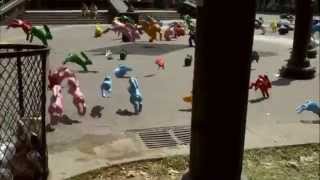
Watch how stop-motion clay rabbits spill out of a drain and multiply across a New York plaza, with stuttering frame-by-frame motion cut against real passers-by until a giant rabbit and the 'Colour like no other' line.
Class question
What does mixing stop-motion with live street footage add to the sense of scale and surprise?
Watch how the chain reaction moves from small dominoes through books, tyres, cars and fire across an Andean village, with crowd reaction shots cut in, building to the tower of objects and the 'Good things come to those who wait' line.
Class question
How do the crowd reaction cuts change the way we feel about a chain of falling objects?
New clip: Same Guinness Tipping Point ad; this complete 90-second copy replaces another fan upload, as Guinness hosts no official version.
04
Visual Comedy
5 references
Technique exercise: watch one clip below twice, once for the story and once counting the cuts. Log three cut points against its "watch for" note, say what each cut does, and propose one alternate cut.
Watch how Isaiah Mustafa talks to camera in what plays as one continuous shot while the set changes around him, from shower to boat to beach, ending on him sitting on a horse.
Class question
Why does hiding the transitions inside one apparent take make the joke funnier than cutting between locations?
Watch the run of failed 'Force' attempts on the dog, the washing machine and the doll, then the payoff when the Passat's lights flash and the cut to the dad pressing the remote in the kitchen.
Class question
How does the repeated set-up of failures make the final reveal land as both a joke and a product demo?
Watch how the cuts between the abandoned lamp in the rain and the warm window with the new lamp invite pity, until a man steps into frame to break the mood.
Class question
How does cutting between the lamp and the window make us feel emotion for an object, and how does the ending undercut it?
Watch how the deadpan presenter interview is cut against clean product inserts of the printed catalogue that mimic a gadget launch video, ending on the 'Experience the power of a book' card.
Class question
Which editing habits of tech launch films does this parody copy, and why does copying them exactly make it funny?
Watch the brisk process montage of bakers mixing, slicing, icing and assembling parts, never showing the whole object until the finished orange Fabia cake stands among the bakers on the turntable.
Class question
How does withholding the full shape of the car until the end turn a process montage into a reveal?
New clip: Same Škoda Fabia Cake ad; this clean 60-second broadcast copy from a Škoda dealer replaces a lower-quality fan upload, as Škoda has no official version online.
05
Emotion & Live Event
5 references
Technique exercise: watch one clip below twice, once for the story and once counting the cuts. Log three cut points against its "watch for" note, say what each cut does, and propose one alternate cut.
Watch how long held shots of an old man alone at Christmas are intercut with his grown children receiving a letter far away, before the family gathers and he steps into the dining room around 1:12.
Class question
How does the slow pacing of the first half set up the emotional payoff of the reveal?
Replaced: Original John Lewis The Bear and the Hare would make a third John Lewis Christmas ad beside slots 22-23, and an interim pick (Google Parisian Love) duplicated ads-branding/17 and technology-gadget-advertising/14. Replaced with the official EDEKA #heimkommen (2015), an iconic Christmas tearjerker with the same melancholic build and emotional reveal.
Original reference: John Lewis — The Bear and the Hare
Watch the montage of a boy impatiently waiting through the days before Christmas, with clocks and calendars, until he skips his own presents on Christmas morning to give his parents a gift.
Class question
How does the montage set us up to misread the boy's impatience, and how does the last scene flip it?
Watch how wide shots of the station concourse show the dance growing from a few people to hundreds, intercut with close reactions of commuters filming and joining in.
Class question
Why does cutting to bystanders' reactions make a staged event feel spontaneous?
New clip: The previous link was T-Mobile's later Heathrow 'Welcome Back' film; this is the original Liverpool Street Dance ad, and T-Mobile UK has no official upload online.
Watch how black title cards frame the experiment as a question and a result ('66% more people than normal chose the stairs'), separating the set-up, the hidden-camera montage and the payoff.
Class question
How do the title cards turn observational footage into an argument with a beginning, middle and end?
New clip: Same Piano Stairs film, now from the campaign's own Rolighetsteorin (The Fun Theory) channel in place of a dealer re-upload.
06
Fashion & Prestige
5 references
Technique exercise: watch one clip below twice, once for the story and once counting the cuts. Log three cut points against its "watch for" note, say what each cut does, and propose one alternate cut.
Watch how the edit cuts between a man and a woman smashing through parallel walls in slow motion until they meet, then follows them out into a forest and a final leap with the 'Freedom to move' line.
Class question
How does cross-cutting two separate runs build the expectation that they will meet?
Watch the black-and-white set-up of a young man buying condoms from a pharmacist, built from tight inserts, then the payoff when the pharmacist turns out to be his date's father, before the 'Watch pocket created in 1873' card.
Class question
How do the small insert shots set up the punchline without any dialogue?
New clip: Same Michel Gondry Levi's Drugstore ad; the previous link was an alternate 'girl version', so this copy of the classic broadcast cut is used (it ends with a short uploader bumper).
Watch how a few long, choreographed takes follow the dancers in Burberry coats through a street hit by ice and storm, ending as one figure walks into the sea before the Burberry card.
Class question
Why does holding long takes during the choreography make the clothes and movement read better than fast cutting would?
Watch how glossy new scenes are cut against VHS-style archive footage with a 'PLAY' tag around 0:52, mirroring the remixed 'My Way' soundtrack before the 'Original is never finished' line.
Class question
How does mixing archive-style and new footage make the edit itself act out the idea of remixing?
Watch the fast backstage montage at Versailles, with brief appearances of Hollywood icons, building to Charlize Theron's walk down the Hall of Mirrors and the bottle shot.
Class question
How does the build from chaotic backstage cuts to one long runway walk create a feeling of arrival?
Replaced: Volvo's Epic Split is not a fashion or prestige film and is already used in another module; Dior's J'adore 'The Future Is Gold' is an iconic luxury film, and no official Dior upload of it is findable.

 1:00